

Picking the perfect bedside lamp starts with one question before you compare finishes: how much of the nightstand space do you need back once the lamp is on it? A good bedside lamp for a small nightstand leaves room for your phone, glass, and book. It should also light the page without glare and switch off without you sitting up.
Fit the bedside lamp to a small nightstand first
Look for the base dimensions in the listing, not just the height. A listing may lead with overall height or shade width, but the base is what actually takes up the table. Then gather everything that sits on your nightstand each night.
Cut a piece of paper to the listed base size and set it on the table with your usual items around it. If your glass ends up hanging near the edge, the base is too large for your setup. A narrow base pushed into a back corner leaves more of the front edge free for what you reach for in the dark. If the surface is already crowded, clear some of it first with these storage ideas for compact apartments. You could also skip the table lamp and choose a plug-in wall sconce. Renters should check the lease before drilling any holes.
If you keep more than a phone on the table, pick the narrowest base that still stands steady.
Check shade height and clearance from the bed
For reading in bed, height matters more than finish. Aim for a shade whose lower edge sits close to your eye line when you sit up to read.
To find that height, sit against your pillows the way you usually read. Mark your eye line on the wall with painter’s tape. Measure from the floor to the tape, then subtract the nightstand height to get a target for the shade’s lower edge. When a listing gives both overall height and shade height, subtract the second from the first to compare. If you already own a table lamp, set it on the nightstand and sit up. If you can see the bare bulb from your pillow, a lamp of that height is too short for your bed.
Next, measure from the wall or headboard to the front edge of the table. Compare that number with the shade diameter. A shade that sticks out past the front edge is the one you will knock reaching for your alarm.
Nightly readers should let shade height decide the purchase, ahead of matching the rest of the room.
Put the switch where your hand lands
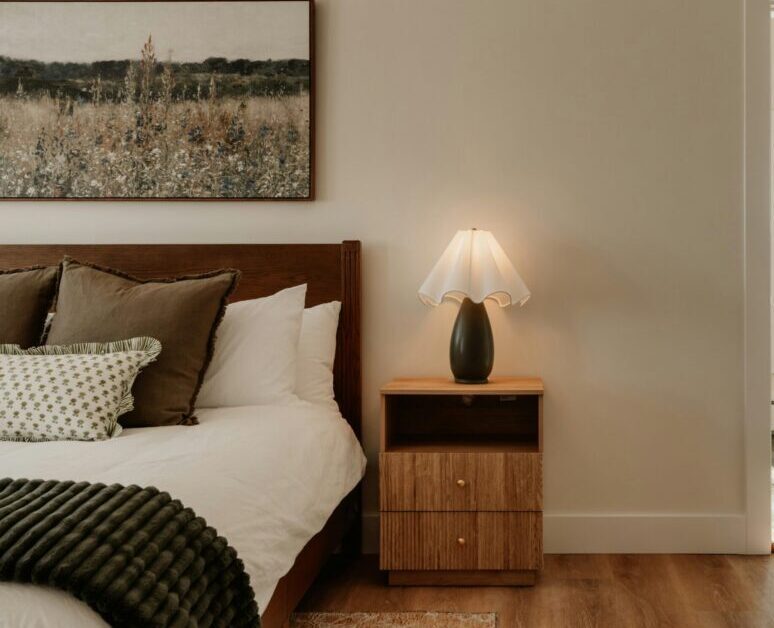
Lie down and reach toward the nightstand with your nearer arm, then notice where your fingers land. Compare that spot with the common switch types:
- Inline cord switch: can rest on the table or near the mattress edge if the cord is long enough.
- Base or touch switch: works well when the lamp sits close to the bed.
- Knob under the shade: means reaching up and under, which is awkward lying down.
- Built-in dimmer: helpful if a partner falls asleep first; buy a bulb marked dimmable on the package.
If switching off without sitting up matters to you, cross knob-under-the-shade lamps off the list first.
Read the bulb details before you buy
Note three things in the listing: the socket base type, the maximum wattage, and whether a bulb is included. Write down the base type before you shop, and don’t assume it matches bulbs you already have.
Judge brightness by lumens rather than watts. As the FTC’s guide to buying light bulbs explains, lumens are the brightness measure, and an old 60-watt incandescent put out roughly 800. The Lighting Facts label on the box also shows whether a bulb leans warm and yellow or cool and blue.
The lamp’s wattage cap refers to the power the bulb actually draws. According to 1000Bulbs, an LED marketed with a higher “equivalent” number is acceptable as long as its true wattage stays below the lamp’s limit.
Lamps with built-in LEDs usually have no bulb to replace. Read their brightness and color specs closely, since you are committing to both. If you can’t predict the brightness you’ll want, a replaceable bulb lets you adjust it after the lamp arrives.
For most readers, the default is a narrow-based lamp with a replaceable warm LED and a switch you can reach lying down. Its shade’s lower edge should sit near your seated eye line.