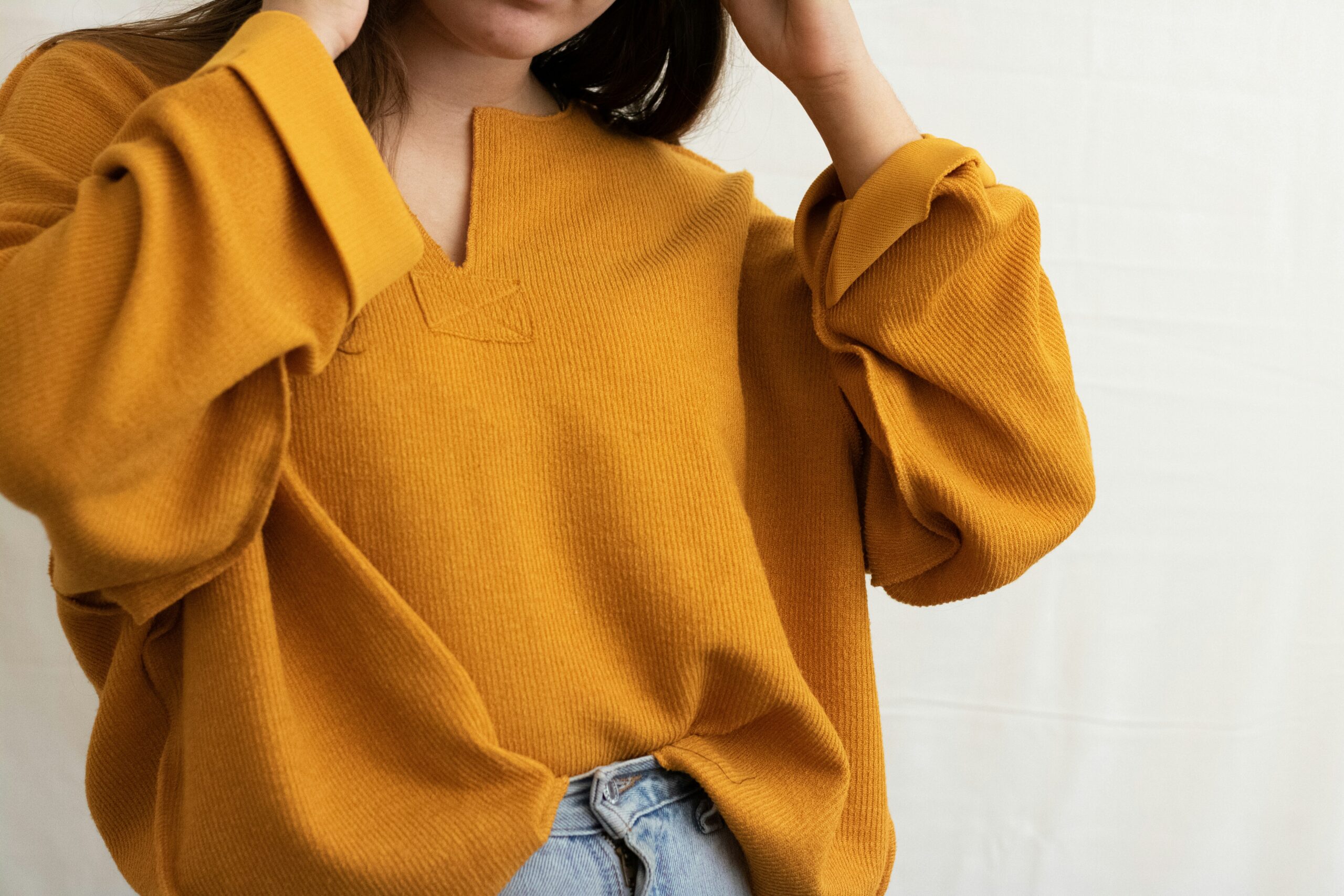
Push the sleeves of an oversized sweater up to just below the elbow, and the outfit changes. A few inches of forearm show, the knit gets a visible edge, and you look like someone wearing a sweater instead of someone hiding inside one.
The size usually isn’t the trouble with a roomy knit. The trouble is that nothing shows where you stop and the wool starts, and the sleeves are the quickest place to fix that.
Start with the sleeves, since they take seconds
Check where the shoulder seam sits. A traditional drop-shoulder sweater has an unshaped armhole and shoulders cut as wide as the chest. That’s why the seam can land on your upper arm and the extra sleeve length can bunch over your hands.
On a fine or mid-weight knit, push the sleeves up to the forearm and let them gather a little. A chunky knit pushed up that far leaves a thick ring at the elbow. Fold the cuff back twice instead so it sits at the wrist bone, which gives you the same edge with less bulk. If the sleeves keep sliding down, slip a thin hair elastic under the scrunch to hold them.
Choose a hem that matches the coverage you want
The hem decides where the eye stops. A French tuck suits loose knits worn with high-waisted jeans and skirts. Tuck just the front, slightly off-center, and let the sides hang. With a thick sweater, tuck only the ribbed band so you don’t get a lump at the waistband.
Would you rather not tuck at all? Fold the hem up and under itself so it sits at your high hip, a soft crop with no extra fabric at the waist. Or belt a mid-weight knit at your natural waist with a slim belt and pull the sweater loose over it. Our belt width guide can help you pick one that won’t vanish under the fabric. For full coverage, leave the hem alone and let your bottoms supply the shape.
Balance an oversized sweater with what’s underneath
Volume on top usually looks best over a slimmer line or a firmer shape. Both work, so pick the one you’d rather wear.
- Slim below: a gray chunky crewneck worn loose over black leggings or slim knit trousers, with knee boots or white sneakers. The narrow legs give the sweater room to be big.
- Structure below: a cream sweater front-tucked into high-rise straight-leg jeans or creased wide-leg trousers, with loafers. The crease and the tuck supply the clean lines the knit doesn’t have.
- Skirt: a navy sweater front-tucked into a satin midi slip skirt, with flat ankle boots. The smooth, swingy fabric keeps all that knit from looking heavy. Our midi skirt formulas have more pairings.
None of this needs a shopping trip. Try the sweater with each pair of trousers and each skirt you own. One will balance it better than the others, and that’s your starting outfit.
Move around before you head out
In front of a full-length mirror, reach up as if for a high shelf, then sit and lean forward. If the tuck pulls free, switch to the hem fold. If the sleeves slip back over your hands, fold them instead of pushing them. If reaching shows more midriff than you’d like, wear the sweater loose and let straight trousers or a skirt do the heavy lifting.
On a rushed morning, do the sleeves and stop there. A cuffed wrist with your usual jeans is enough to get a big sweater out the door, and the tuck can wait for a morning with a few spare minutes.